
Department of Energy Award to Power Nuclear Research with Machine Learning
The future of clean energy depends on algorithms as much as it does atoms.
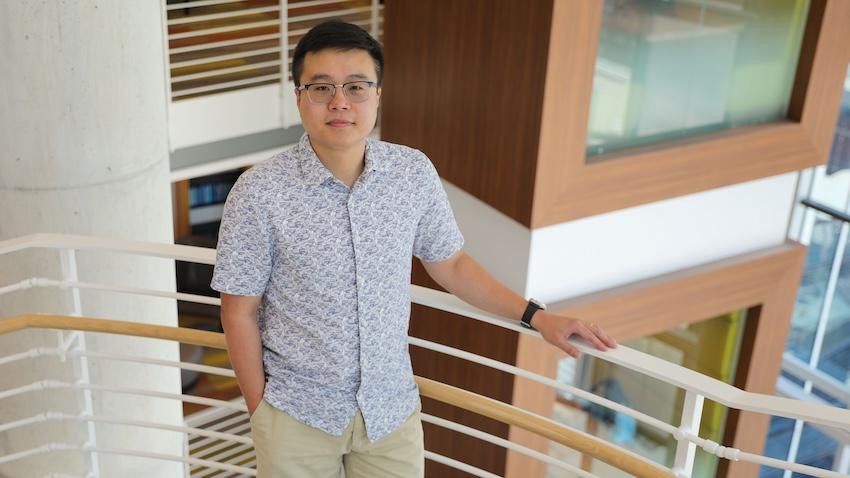
Georgia Tech’s Qi Tang is building machine learning (ML) models to accelerate nuclear fusion research, making it more affordable and more accurate. Backed by a grant from the U.S. Department of Energy (DOE), Tang’s work brings clean, sustainable energy closer to reality.
Tang has received an Early Career Research Program (ECRP) award from the DOE Office of Science. The grant supports Tang with $875,000 dispersed over five years to craft ML and data processing tools that help scientists analyze massive datasets from nuclear experiments and simulations.
Tang is the first faculty member from Georgia Tech’s College of Computing and School of Computational Science and Engineering (CSE) to receive the ECRP. He is the seventh Georgia Tech researcher to earn the award and the only GT awardee among this year’s 99 recipients.
Georgia Tech’s Qi Tang is building machine learning (ML) models to accelerate nuclear fusion research, making it more affordable and more accurate. Backed by a grant from the U.S. Department of Energy (DOE), Tang’s work brings clean, sustainable energy closer to reality.
Tang has received an Early Career Research Program (ECRP) award from the DOE Office of Science. The grant supports Tang with $875,000 dispersed over five years to craft ML and data processing tools that help scientists analyze massive datasets from nuclear experiments and simulations.
Tang is the first faculty member from Georgia Tech’s College of Computing and School of Computational Science and Engineering (CSE) to receive the ECRP. He is the seventh Georgia Tech researcher to earn the award and the only GT awardee among this year’s 99 recipients.
Recent Stories
CSE Leadership Transition Comes as School…
Thursday, August 27, 2026
Open Source, Big Ideas: Scientific…
Wednesday, August 26, 2026
New Model Teaches Workplace AI to Read More Like Humans
Wednesday, August 12, 2026